The UK Automotive Market Isn't Evolving. It's Being Reinvented.
06th Aug 2026
EVs may dominate the conversation but, the real disruption is coming from the manufacturers selling them.
Thoughts by Driveway Vehicle Solutions' Head of Sales, Paul Murdoch.
For years, our industry has obsessed over one question:
When will EVs take over?
According to the latest SMMT data, that may no longer be the most interesting question. The bigger story emerging from the UK’s registration figures is not electrification alone. It's disruption.
While much of our industry has been focused on battery technology, EV charging infrastructure and the forever-challenging government mandates, a new group of manufacturers has quietly walked straight through the front door and started taking customers from across the market.
And they are doing it at a remarkable pace.

The biggest automotive story nobody can ignore
A few years ago, Chinese brands were viewed with curiosity. Today, they are being taken very seriously. Tomorrow, some of them may be viewed as market leaders.
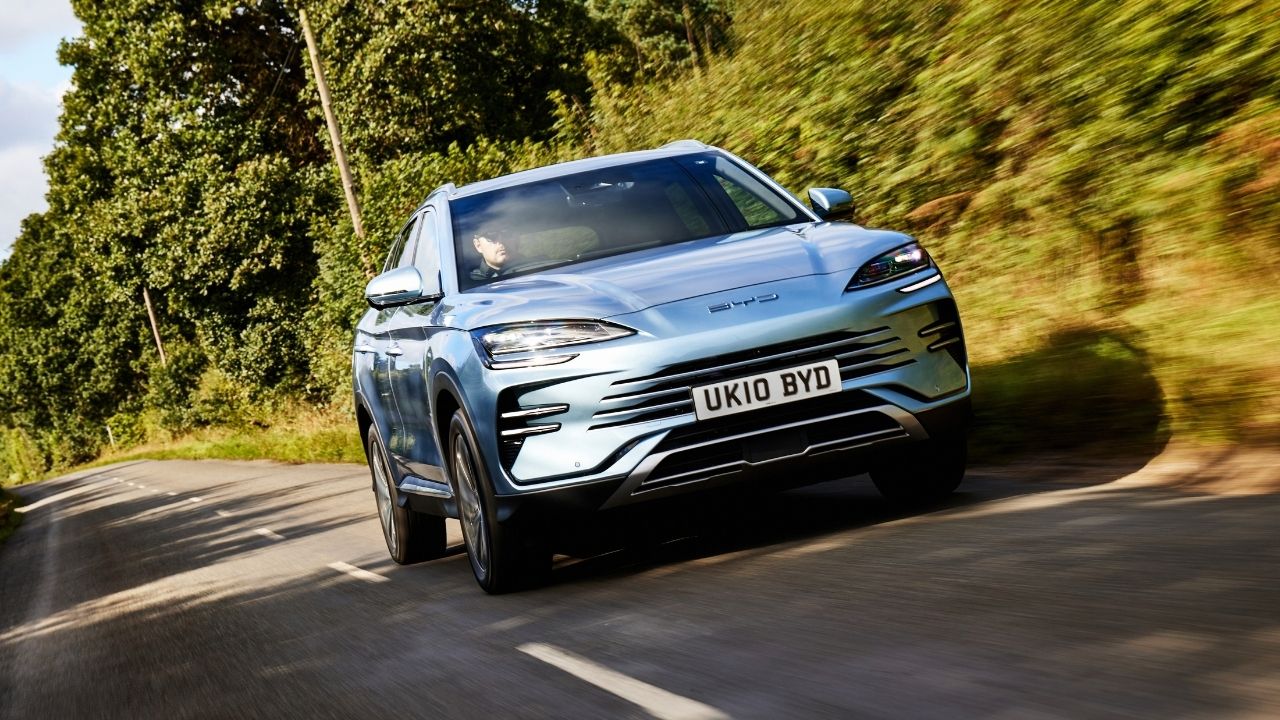
The likes of BYD, OMODA and JAECOO, alongside the more established Chinese-owned MG, are not arriving in the UK market. They have already arrived.
During the first half of 2026, BYD registrations increased by 94.9% compared with the same period in 2025. OMODA grew by 170.3%, while JAECOO increased its registrations by 305.6%. MG, which already has a much more established UK presence, grew by a still significant 14.4%.
According to SMMT UK car registration data from June 2026, the JAECOO 7 was also the UK’s third most-registered new car during the first six months of 2026, behind only the Ford Puma and Kia Sportage.
These brands are winning customers through a combination of aggressive pricing, high levels of standard specification, distinctive designs and technology-first vehicles.
The established manufacturers should be asking themselves a difficult question:
What happens when consumers stop paying extra for a badge?
That may not be happening across the whole market just yet. Brand heritage, trust, aftersales support, dealer coverage and residual values still matter. But there are clear signs that a familiar badge on the bonnet may no longer be enough on its own.
The threat to traditional manufacturers is not simply Tesla anymore. It is a wave of new brands offering more car for less money and forcing buyers to rethink what good value looks like.
The winners aren't who they used to be
Historically, success in the UK automotive market was fairly predictable. German brands such as Volkswagen, BMW and Audi regularly dominated the conversation, while Ford and Vauxhall were among the familiar names fighting for volume.Today, it all feels very different.
Some of the fastest-growing brands have little UK heritage, relatively new dealer networks and virtually no legacy customer base. Yet plenty of us are buying them, or at least seriously considering them.
The BYD Seal U, for example, was the fifth most-registered electrified vehicle in the UK during 2025, with 20,784 registrations. It is worth noting that this was mainly driven by the plug-in hybrid version rather than the fully electric model, but it still shows just how quickly a relatively unfamiliar name can gain serious traction.
Why is this happening?
Because buyers are becoming less concerned about where a brand came from and more interested in whether the product offers genuine value.
Does it look good? Is it well equipped? Does it have the technology people want? Is the range suitable? And, most importantly, can they afford it?
It is almost as though some buyers are becoming less defined by the badge they drive. That does not mean brand loyalty has disappeared, but it does mean it can no longer be taken for granted.
Loyalty now has to be earned through the vehicle, the price and the ownership experience. Right now, that is a showroom battle some long-established manufacturers seem to be struggling to win.
EVs are accelerating this, but is it fast enough?
Briefly, let’s consider the industry’s favourite topic: electric vehicles. Don’t groan just yet.
The good news is that EV registrations continue to rise strongly and now make up a significant proportion of the UK market.
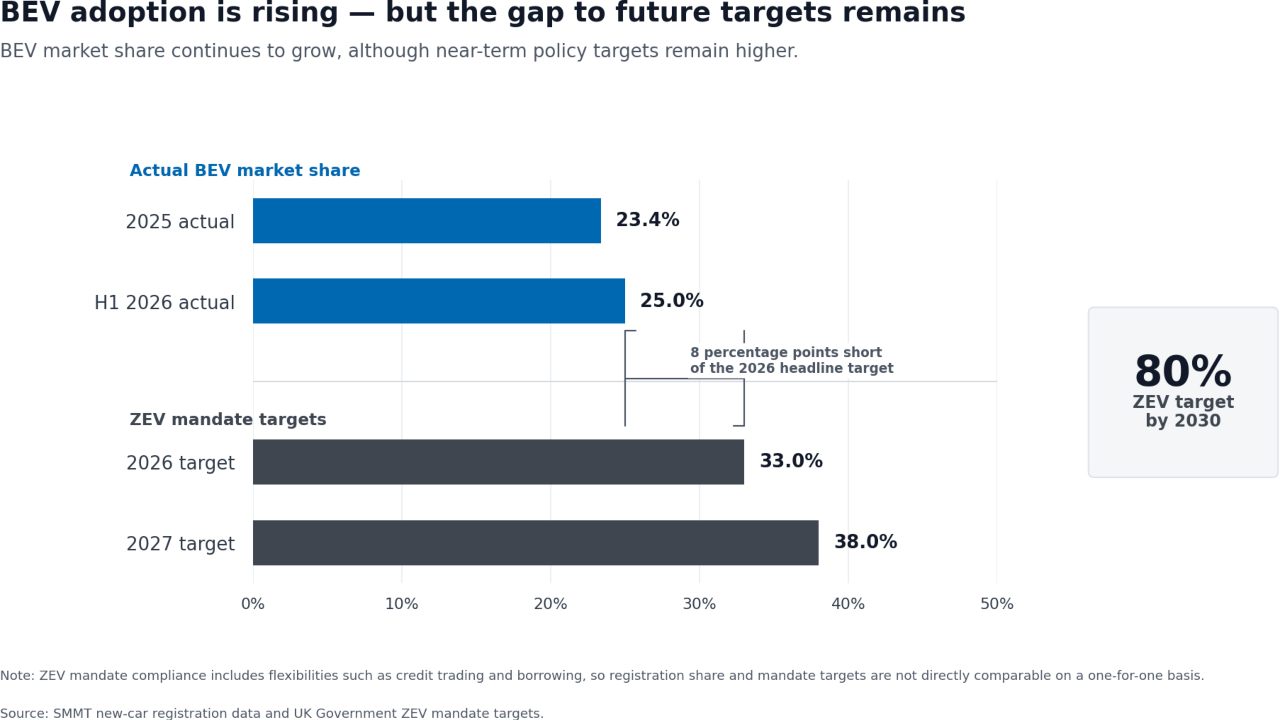
That growth has continued into 2026. During the first half of the year, 284,579 BEVs were registered, which was 26.6% ahead of the same period in 2025. Fully electric cars represented around a quarter of all new-car registrations during that period. That is real progress. The bad news, according to some, is that it is still not enough.
The headline ZEV mandate target for cars rises to 33% in 2026, 38% in 2027 and 80% by 2030. There are important flexibilities built into the rules, including credit trading and borrowing, so national BEV market share cannot be compared directly with manufacturer compliance on a simple one-for-one basis.
However, even with those flexibilities, the gap between current demand and the direction of government policy remains clear. This is where the debate gets interesting, because there are two very different stories being told.
Story One
Consumers are embracing EVs, registrations are increasing and the transition is working.
Story Two
Manufacturers are working incredibly hard, and spending billions, to create demand that is still not occurring naturally at the pace government expects.
The truth probably sits somewhere in the middle.
More drivers are choosing electric vehicles. The choice of models is improving, range is increasing, charging infrastructure is growing and electric cars are becoming more familiar. At the same time, manufacturers are using significant discounts and incentives to help stimulate that demand.
The SMMT estimated that manufacturers provided more than £5 billion of discounts across the BEV market during 2025, equivalent to around £11,000 for every new BEV registered. That is an industry-wide estimate rather than a confirmed discount on every vehicle, but it does give an indication of the amount of financial support being used to keep the market moving.
So here is the question:
If manufacturers removed those discounts tomorrow, would EV demand continue growing at the same rate?
If the answer is no, then something must change. Either more needs to be done to support demand and keep the current rate of growth going, or targets need to be adjusted to make the transition more sustainable.
The market is growing but, how healthy is it?
At first glance, the latest figures look encouraging.
Registrations are up.
UK new-car registrations reached 2.02 million units in 2025, up 3.5% year on year and the highest annual total since before the pandemic. It was also the third consecutive year of market growth.
Fleet registrations increased by 2.6%, business registrations rose by 8.8% and private registrations grew by 4.5%. Growth has continued into 2026. During the first six months of the year, total new-car registrations reached 1,137,929, up 9.2% compared with the first half of 2025. Private registrations increased by 12.6%, while fleet registrations grew by 6.8%. That improvement in private demand should not be ignored, but fleet still accounted for 58% of registrations during the first half of 2026, compared with 39.8% for private buyers.
That matters. It really matters. Fleet buyers often behave differently from private consumers. Fleet decisions are usually driven by whole-life costs, emissions policies, taxation, company-car choice lists, operational requirements and vehicle availability. Private consumers are more likely to balance cost with emotion. They consider the badge, the design, how the vehicle makes them feel and whether they can picture themselves owning it.
Historically, consumer demand has been one of the clearest indicators of genuine market confidence. That does not mean fleet demand is artificial or somehow less valuable. Fleet registrations put more low-emission vehicles on the road, give more drivers direct experience of EVs and help to build the future used-car market.
However, headline registration growth does not tell us everything. We also need to understand who is registering the vehicles, why they are choosing them and how much financial support has been required to make the deal work.
New entrants are increasing competition
The rapid growth of BYD, JAECOO, OMODA and other newer manufacturers is creating more choice for both fleets and consumers, particularly across the EV and plug-in hybrid markets. For customers, that competition should be a good thing. More manufacturers mean more models, more pressure on pricing and a stronger reason for every brand to improve its product. For established manufacturers, though, it creates a serious challenge.
They are no longer only competing with the brands they have known for decades. They are competing with manufacturers that can launch new models quickly, include more equipment as standard and enter the market with fewer expectations around what their vehicles should cost.
The old rules are being rewritten.
The next battle will be won on affordability
The automotive industry talks endlessly about cost. Consumers talk endlessly about value. They are not always the same conversation.
The dominant manufacturers over the next five years will not necessarily be those with the fastest charging speeds, the prettiest vehicles, the biggest touchscreens or the smartest artificial intelligence. They will be the brands that can answer one simple customer question:
Can I afford it?
That is where many Chinese manufacturers are currently making life uncomfortable for traditional OEMs. They are not merely competing on technology. They are competing on economics and challenging what customers expect to receive as standard for their money. And economics tends to win.
Established manufacturers still have major advantages. They have strong brands, large dealer networks, established aftersales operations, proven finance products, parts availability and years of customer trust.
But they can no longer assume those advantages will always outweigh a major difference in price or specification. The question is whether established manufacturers can respond quickly enough to get back in the fight, or whether some will slowly lose relevance as the market moves on around them.
Don't ignore commercial vehicles
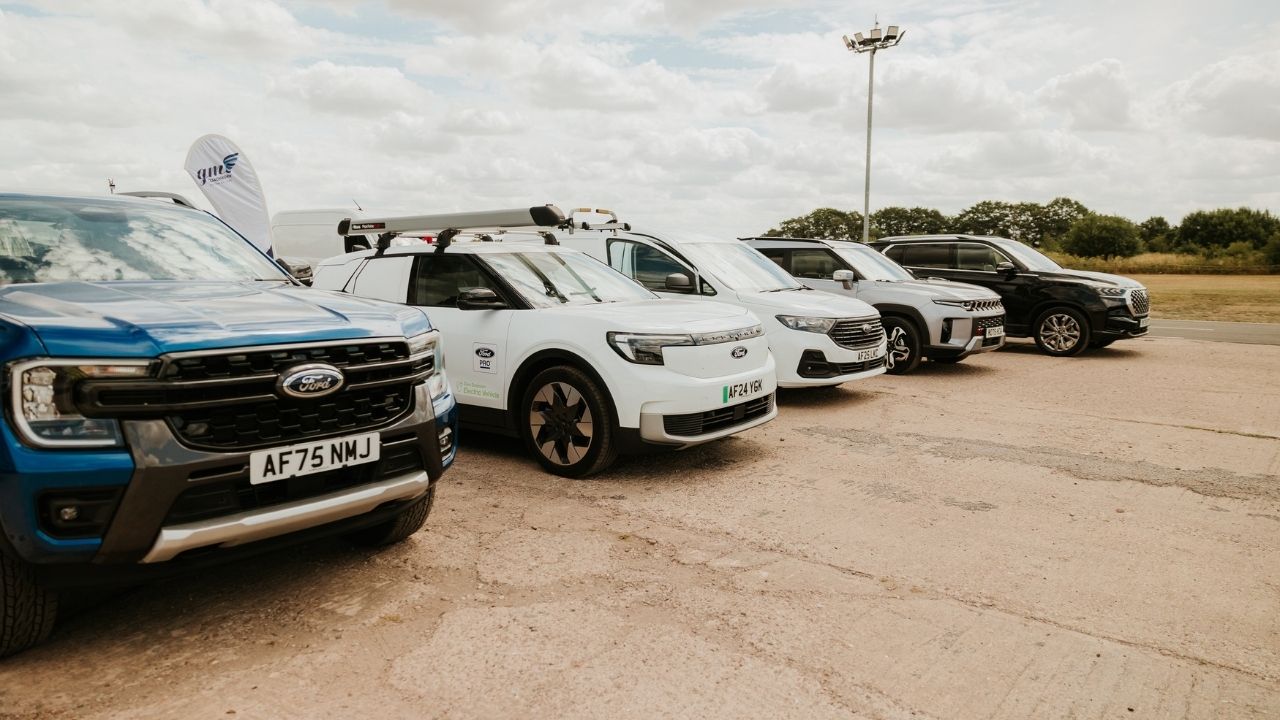
While the car market gets most of the headlines, it is the light commercial vehicle market that quietly keeps Britain moving.
Many of the questions facing car buyers are even more challenging for van operators. Can it do the job? Can it carry the right payload? Can it be charged conveniently? What happens during downtime? Can we rely on the range throughout winter? Is there enough service and parts support? Can we trust the residual values? And does the total cost genuinely stack up against diesel?
For many fleet operators, the electric-van conversation remains far more complicated than the electric-car conversation.
Battery-electric van registrations increased during the first half of 2026, but their share of the new LCV market stood at only 9.9%. The ZEV mandate target for vans is 24% in 2026, rising to 34% in 2027 and 70% by 2030.
The choice of electric vans is improving and registrations are increasing, but the gap between electric-car and electric-van adoption remains significant. A car mainly needs to satisfy its driver. A commercial vehicle has to perform a job, protect productivity and keep a business moving.
Over the next few years, that may become one of the industry’s biggest stories. The question is whether it will become a story of successful transition or one of targets moving faster than the market can realistically follow.
What does this mean for fleets?
For fleet operators, all of this creates both opportunity and risk. More manufacturers mean more choice, stronger competition and potentially better value. However, unfamiliar brands and new technology also require more detailed evaluation.
Vehicle decisions cannot be based on badge, list price or electric range alone. Fleets need to consider whole-life cost, real-world range, vehicle uptime, driver acceptance, aftersales coverage, parts availability, insurance, repair capability, residual values and the level of support available from the manufacturer and dealer network.
The fleets that benefit most will be those that remain open to new manufacturers without being distracted by a long specification list or a low headline price. The right vehicle is not automatically the cheapest one. It is the one that delivers the strongest overall result for the business, its drivers and its day-to-day operation.
My final thoughts
A new generation of manufacturers is reshaping the competitive landscape. Consumer loyalties are changing, the definition of value is changing and the route to gaining market share is changing with it. For many established brands, the uncomfortable reality is this:
The biggest threat is not the move to EVs. It is who is going to be selling them.
For support with your fleet in this ever-changing market. Speak to our team today. Data correct at the time of writing and based on published SMMT figures covering the period to June 2026.